

Process specifications and input/output designs are crucial in the pharmaceutical industry for quality and compliance. They define how input data transforms into output, guiding regulatory requirements and enhancing data quality through structured documentation and effective design.
In the pharmaceutical industry, the creation and management of process specifications and input/output designs are essential for ensuring quality and compliance. These elements help define how input data is transformed into output data, establishing a framework for regulatory and engineering requirements.
Defining Process Specifications

Process specifications are integral to documenting decisions made based on input data, ultimately guiding the generation of output data. They provide a structured approach to articulating requirements and procedures that align with regulatory standards. A well-developed process specification enhances data quality and consistency while minimising ambiguity. This clarity allows stakeholders to understand the tasks accomplished and validate the system's design through data dictionaries and flow diagrams.
Process specifications can be created for both basic processes, known as minispecs, and more complex data flow diagram processes. Communication tools such as formulas and algorithms play a pivotal role in conveying engineering requirements to those involved in process development. Various methods, including structured English, decision tables, and decision trees, serve to represent process logic effectively. However, for processes that involve existing code or simple data validation, formal process specifications may not be necessary.
Designing Inputs and Outputs
Input Design Considerations
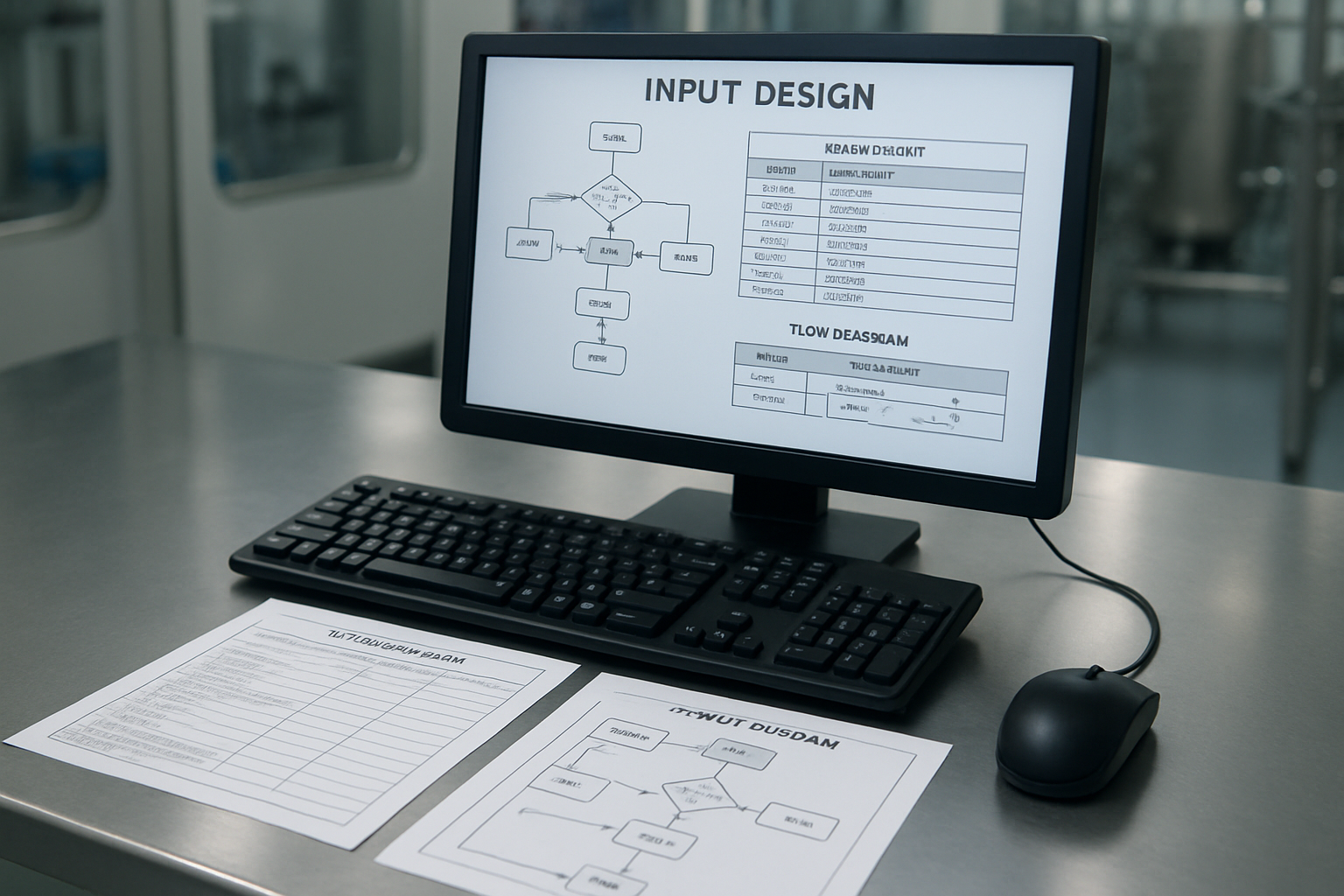
When raw data is introduced into an information system, it undergoes processing to yield meaningful output. The design of input devices must consider the various methods of data entry, such as PC, MICR, and OMR. The quality of the output is directly influenced by the quality of the input, making effective input design crucial.
Key characteristics of well-designed input screens and forms include:
- Effective storage, recording, and retrieval of information
- Accuracy in data completion
- Consistency and simplicity to enhance user engagement
To achieve these objectives, designers must understand user interactions with input interfaces and develop procedures that streamline data entry. This includes reducing input volume and designing source documents that facilitate data collection. Input integrity is maintained through various controls, such as value checks for format and completeness, alongside transaction logs that track entries and system operations for security and recovery.
Output Design Objectives
The design of outputs must align with user requirements while eliminating unnecessary information. Effective output design ensures that results are accurate, timely, and presented in an appropriate format. Outputs can be classified into external and internal categories.
External outputs, produced by external printers, allow recipients to follow up on actions or confirm transactions. Turnaround outputs are designed to be re-entered into the system as inputs. Internal outputs, accessible to users and managers, support reporting and decision-making processes. These internal outputs can take the form of:
- Detailed Reports: Contain filtered information, limiting their use for management planning.
- Exception Reports: Highlight deviations by presenting filtered data to management.
- Summary Reports: Provide a high-level overview of trends and potential issues without excessive detail.
Output integrity is further reinforced through routing codes that identify recipient systems and verification messages that confirm successful message handling. Reports should include essential information such as date/time, titles, and version numbers for clarity and accountability.
Understanding the Process Life Cycle
The process life cycle encompasses various states that a process may encounter from initiation to execution. Operating systems typically recognise five states:
- Process State: Acknowledges the submission of a process request.
- Ready State: The process awaits assignment to a processor.
- Running State: The process is actively executing.
- Waiting State: The process is paused, often due to resource requests or priority interruptions.
- Termination State: The process concludes once it has completed its execution.
Processes may transition through various states based on resource availability and operational priorities. A process can directly move to termination if all required resources are available. Alternatively, it may need to wait if resources are being utilised by other processes or if higher-priority operations interrupt its execution. Understanding these transitions is vital for effective process management in pharmaceutical environments.
Comments (0)
Loading comments…
Checking sign-in status…