

Receptors play a vital role in pharmacology by detecting stimuli and facilitating signal transduction. They can be classified by structure, function, and location, with various regulatory mechanisms influencing their activity.
Receptors are critical components in pharmacology, allowing cells to detect and respond to a variety of stimuli from both internal and external environments. Their role in signal transduction is essential for numerous physiological processes and therapeutic interventions.
The Mechanisms Behind Receptor Functionality

Two primary theories elucidate the operational mechanisms of receptors: the lock-and-key concept and the induced-fit model.
Lock-and-Key Concept
This model posits that receptors are highly specific and can only interact with particular molecules, akin to a key fitting into a lock. The specificity arises from the precise geometric compatibility between the receptor and the ligand. For instance, a molecule will only elicit a response if it has the right configuration to fit into its corresponding receptor.
Induced-Fit Model
This approach suggests a more dynamic interaction, where receptors can modify their shape to accommodate a molecule during binding. The flexibility inherent in this model allows for a more versatile signaling response. When a molecule binds, the receptor undergoes conformational changes, enhancing its ability to interact with additional molecules of a similar type.
Receptor Classification Systems
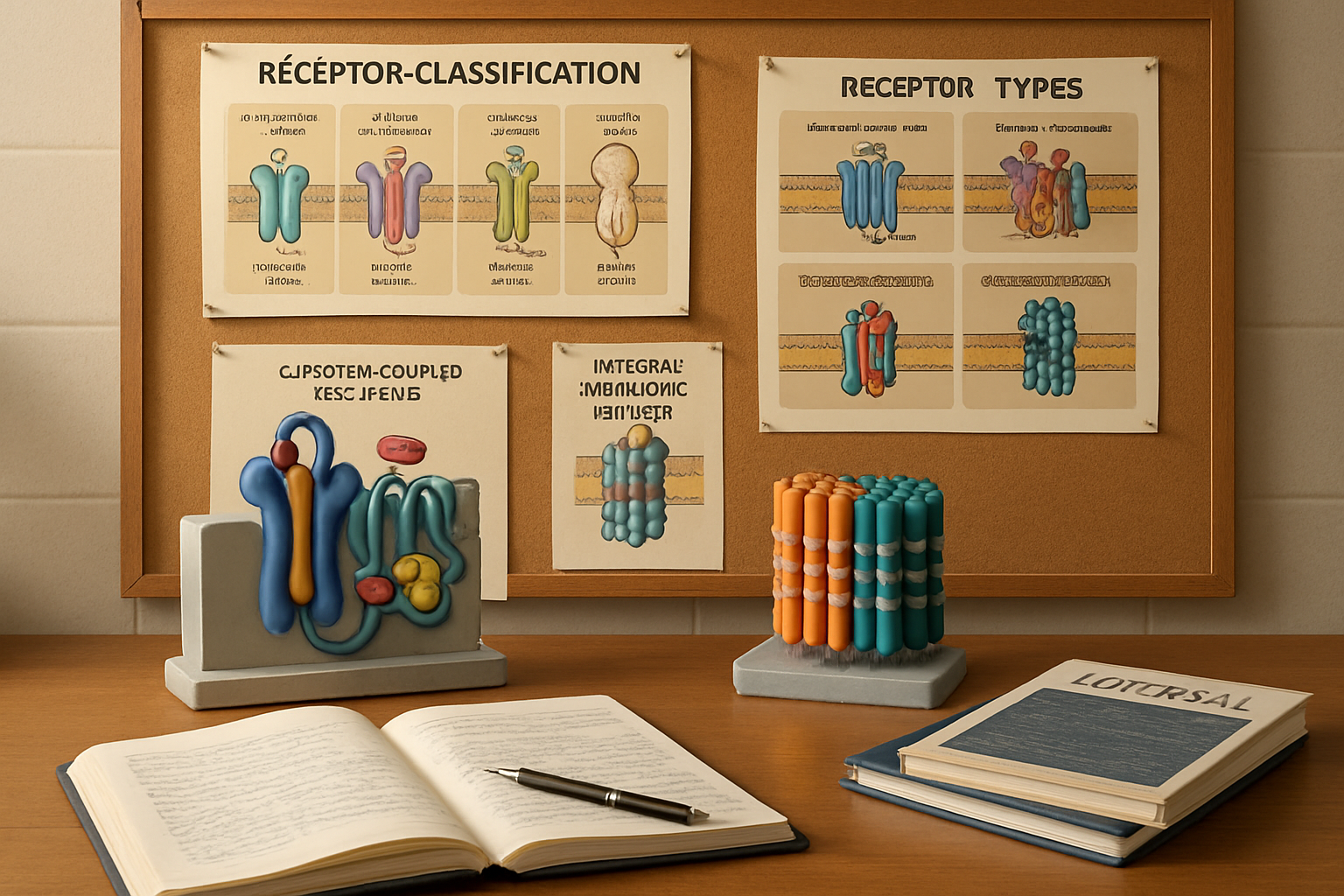
Receptors can be categorised based on various criteria, including their structural characteristics, functional roles, and spatial distribution within the body.
Structural Categorisation
Receptors can be divided into two primary structural types: integral membrane proteins and G protein-coupled receptors (GPCRs). Integral membrane proteins are embedded within the cell membrane and facilitate signal transmission across the membrane. Within this category, receptors can be further divided into ion channels that modulate ionic movement and receptor proteins that directly mediate signal transduction.
Functional Categorisation
From a functional standpoint, receptors can be classified into five main groups:
- Ion Channels: These allow ions to flow in and out of cells, influencing their electrical activity.
- Enzymatic Receptors: These bind to ligands, activating or inhibiting enzymatic functions.
- Receptor Proteins: These specifically interact with hormones and other signalling molecules.
- G Protein-Coupled Receptors (GPCRs): These are activated by binding to G proteins, triggering intracellular responses.
Spatial Distribution
Receptors can also be classified based on their location in the body, which includes:
- Cell Surface Receptors: Positioned on the cell membrane.
- Nuclear Receptors: Found within the cell nucleus.
- Intracellular Receptors: Located inside the cytoplasm.
Receptor Regulatory Mechanisms
The activity of receptors is modulated through various regulatory mechanisms, which can be either enhancing or inhibitory.
Enhancing Regulatory Mechanisms
Positive regulation occurs when certain molecules elevate receptor activity. This can happen through:
- Activation: Direct stimulation of the receptor enhances its responsiveness.
- Ligand Binding: The presence of a ligand can amplify receptor activity.
- Phosphorylation: The addition of phosphate groups can increase receptor activity.
Inhibitory Regulatory Mechanisms
Conversely, negative regulation leads to a decrease in receptor activity. This includes:
- Downregulation: A reduction in the quantity of receptors on the cell surface.
- Desensitisation: The receptor's responsiveness diminishes over time with continuous stimulation.
- Phosphorylation: In this context, it may decrease activity by modifying receptor conformation.
- Ubiquitination: The marking of receptors for degradation by ubiquitin ligases.
Comments (0)
Loading comments…
Checking sign-in status…