
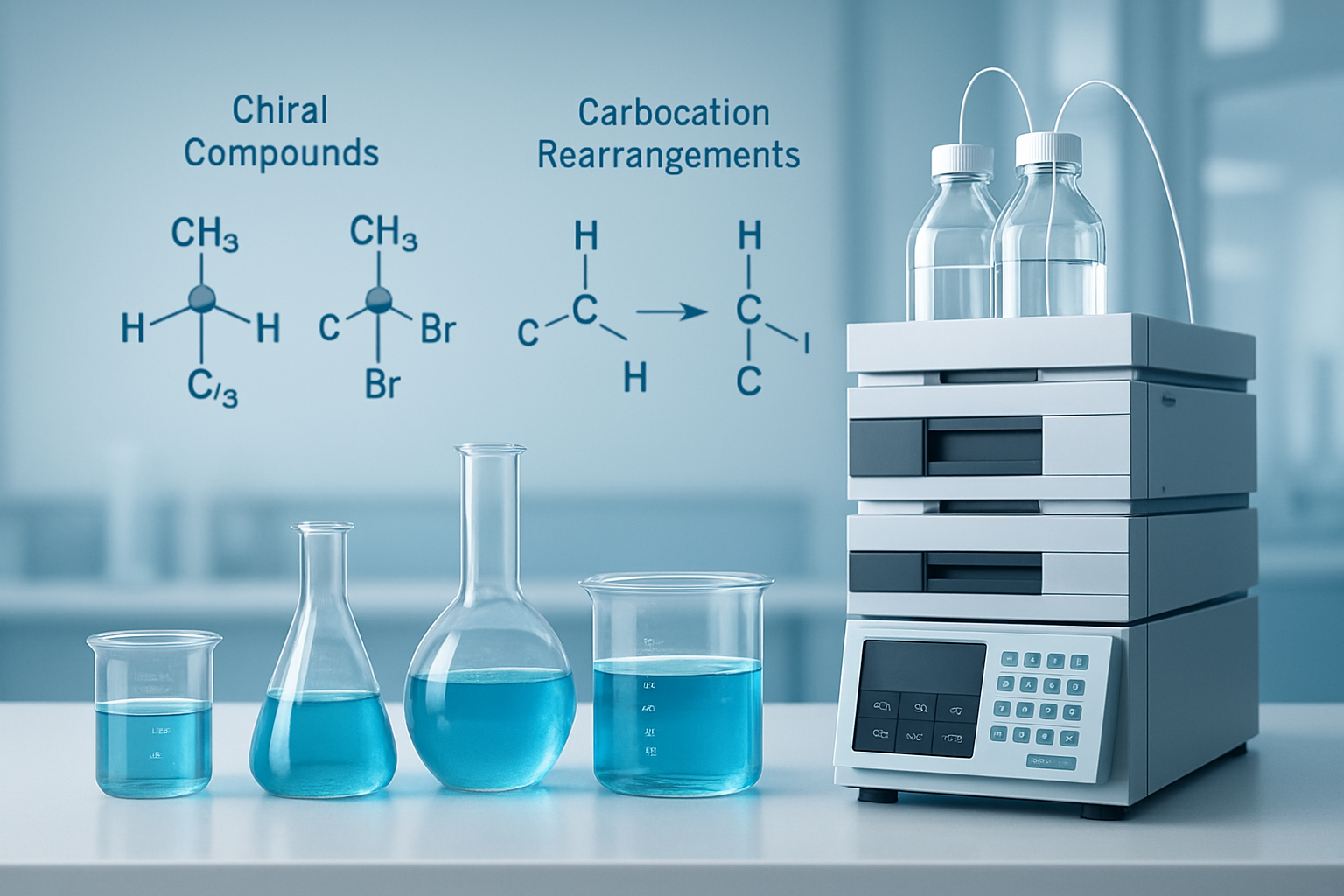
Stereochemistry focuses on the spatial arrangement of atoms in molecules, influencing their behavior and properties. Carbocation rearrangements, including hydride and alkyl shifts, are key mechanisms that enhance stability in organic reactions.
Stereochemistry plays a crucial role in understanding molecular structures and reactions in organic chemistry. It focuses on the spatial arrangement of atoms within a molecule, which can significantly influence the behaviour and properties of compounds. The origins of stereochemistry trace back to 1842 when Louis Pasteur discovered that certain salts of tartaric acid could rotate plane-polarized light, a phenomenon that highlighted the importance of molecular geometry.
Principles of Stereochemistry
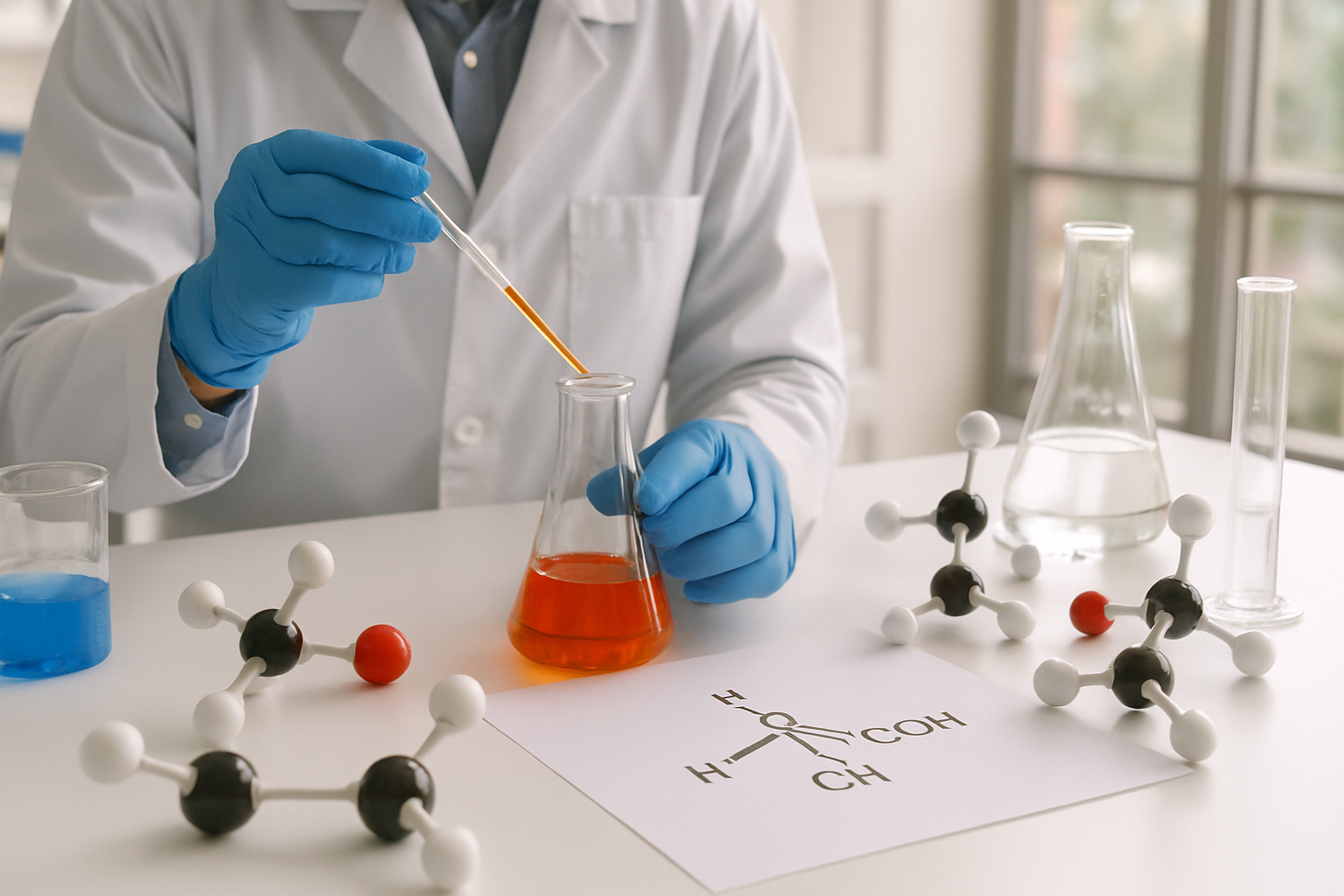
The term 'stereochemistry' refers to the chemistry of spatial arrangements. Molecules can exhibit optical isomerism, where their three-dimensional structures result in non-superimposable mirror images, known as chiral molecules. This aspect of stereochemistry is vital for understanding reactions and interactions in biological systems, as many biological molecules are chiral.
Dynamic stereochemistry is another important area that examines how different spatial arrangements of atoms can affect reaction rates. By studying these variations, chemists can predict and manipulate the outcomes of chemical reactions more effectively.
Carbocation Rearrangement Mechanisms
Loading flowchart…
In organic chemistry, carbocations are positively charged species that can undergo rearrangements to achieve greater stability. The rearrangement process typically involves structural changes in the molecule, allowing it to transition from an unstable to a more stable state. Carbocations can be generated from various substrates, including alkyl halides, alcohols, and alkenes. There are two primary types of rearrangements: hydride shifts and alkyl shifts.
Hydride Shift Mechanism
A hydride shift involves the transfer of a hydrogen atom from one carbon to an adjacent carbon atom, particularly when the latter is less substituted. This process is common in reactions involving strong acids such as HBr, HCl, and HI, which can react with alcohols to facilitate this rearrangement.
For example, in the presence of hydrogen chloride, an alcohol undergoes a reaction where the hydroxyl (-OH) group is replaced by a chlorine atom. This substitution does not happen directly; rather, it involves the formation of a carbocation intermediate that undergoes a hydride shift before the final product is formed.
Alkyl Shift Mechanism
In cases where carbocations are secondary or tertiary but lack suitable hydrogen atoms for a hydride shift, alkyl shifts become relevant. This type of rearrangement involves the migration of an alkyl group to a neighbouring carbocation. During this process, an electron pair from the migrating alkyl group forms a new bond with the adjacent carbocation, effectively transferring the alkyl group.
Alkyl shifts are particularly significant because they often lead to the formation of more stable tertiary carbocations from less stable primary or secondary ones. This stability is critical for the reaction pathways and products that emerge from carbocation intermediates.
Conclusion
Understanding the principles of stereochemistry and the mechanisms of carbocation rearrangements is essential for chemists in predicting reaction outcomes and designing new synthetic pathways. Both hydride and alkyl shifts illustrate the dynamic nature of molecular interactions and the importance of molecular stability in organic chemistry.
Comments (0)
Loading comments…
Checking sign-in status…