

Cleaning validation in pharmaceutical manufacturing requires accurate Maximum Allowable Carryover (MACO) calculations to prevent cross-contamination. Establishing scientifically justified MACO values is essential for compliance and patient safety, relying on robust data and documentation practices.
Cleaning validation is a critical element of pharmaceutical manufacturing, ensuring that production equipment is thoroughly cleaned to prevent cross-contamination between different products. Regulatory authorities mandate that companies define maximum allowable residue levels to demonstrate effective cleaning processes. The Maximum Allowable Carryover (MACO) represents the highest permissible residue left from a previously manufactured product onto the next product, ensuring patient safety is not compromised.
Accurate MACO calculations are essential for establishing analytical acceptance criteria and determining the acceptability of cleaning validation results. Despite its importance, many professionals struggle with the nuances of these calculations, often relying on outdated information or assumptions. Establishing credible MACO values requires robust scientific evidence and a thorough understanding of the underlying principles.
Significance of MACO in Cleaning Validation

Defining acceptable contamination levels is foundational for effective cleaning validation tests. Establishing a scientifically justified MACO plays a crucial role in:
- Safeguarding patients from potential cross-contamination
- Setting criteria for acceptable residue levels
- Supporting cleaning validation protocols
- Demonstrating compliance with Good Manufacturing Practices (GMP)
- Providing a consistent framework for analytical testing
- Guiding decisions regarding risk-based validation
Regulatory guidelines increasingly favour health-based exposure limits over arbitrary figures, allowing for more precise and rational standards.
Concept of Residue Carryover
To illustrate the concept of carryover, consider two scenarios: Product A is produced one day, followed by Product B the next day using the same equipment. Even after a thorough cleaning, traces of Product A may persist on the surfaces. The goal of cleaning validation is not simply the absence of residues, but rather to verify that any remaining residue is below an acceptable scientific threshold, safeguarding the patients receiving Product B.
Necessary Data for MACO Calculation
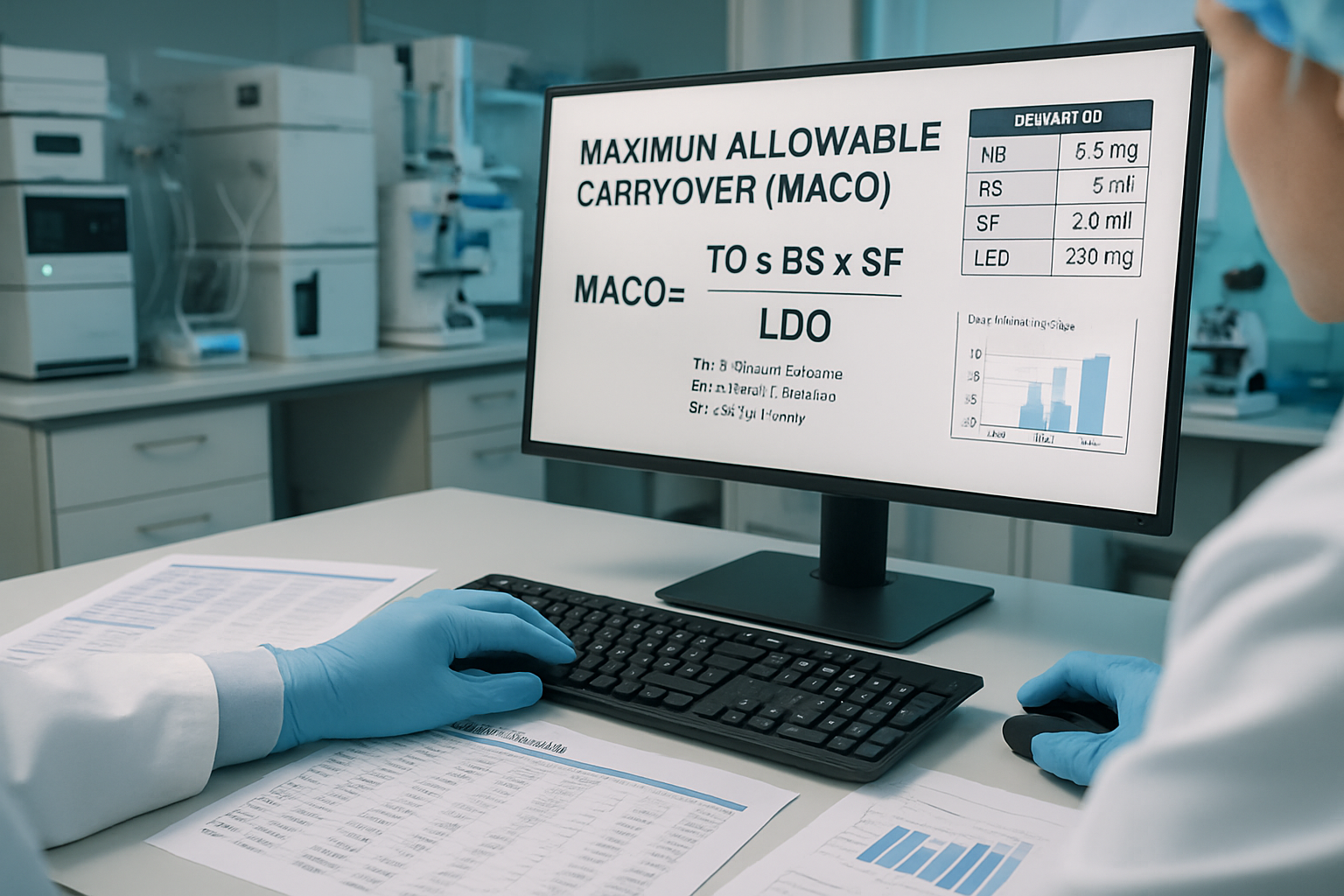
Before undertaking MACO calculations, specific product and process information is vital:
- Therapeutic dose of the previous product
- Minimum daily dose of the subsequent product
- Health-Based Exposure Limit (HBEL), Acceptable Daily Exposure (ADE), or Permitted Daily Exposure (PDE)
- Batch size of the next product
- Total surface area of shared equipment
- Area designated for swab sampling
- Recovery factor from swabs
- Toxicological data pertaining to the product
Incomplete data can result in invalid limits, rendering the calculation unreliable.
Methods for Calculating MACO
Loading flowchart…
Historically, several methods have been used to calculate MACO, with a shift towards those rooted in health-based exposure limits as the preferred approach today. The following methods are widely recognised:
- Therapeutic dose method
- 10 ppm method
- Health-Based Exposure Limit (HBEL/PDE/ADE) method
The HBEL method is currently considered the scientific standard.
Identify Health-Based Exposure Limit
The initial step involves determining the maximum Permitted Daily Exposure (PDE), Acceptable Daily Exposure (ADE), or another established health limit for the previous product. These figures are derived from toxicological studies, considering factors such as:
- Pharmacological action
- Toxicity
- Genotoxicity
- Carcinogenicity
- Reproductive toxicity
- Safety factors
In the absence of an official PDE, its value must be determined by a qualified toxicology expert.
Determine the Next Product's Batch Size
The permissible residue carryover is influenced by the batch size of the subsequent product. For example, if Product A has a potency of 2 mg per day, and the next product (Product B) has a batch size of 500 kg, larger batches allow for more effective dilution of any residue. Always use the smallest commercial batch size to identify the worst-case scenario, minimising waste dilution.
Utilise the MACO Formula
Using the health-based method, the MACO can be calculated using the formula:
MACO = (PDE × Batch Size of Next Product) / Maximum Daily Dose of Next Product
Where:
- PDE = Permitted Daily Exposure of the previous product
- Batch Size = Smallest batch size of the next product
- Maximum Daily Dose = Maximum dose of the next product
This calculation yields the maximum allowable carryover for the manufacturing batch.
Overview: convert MACO to Surface Residue Limits
The calculated MACO must then be converted into a usable surface residue limit for verification through swab sampling. This is achieved by dividing the MACO by the total contact surface area of the equipment. For instance, if the total surface area of the equipment is 40,000 cm² and the MACO is 200 mg, the surface limit would be:
Surface limit = 200 mg / 40,000 cm² = 0.005 mg/cm²
This result provides the acceptance criterion for sampling.
Overview: adjust for Swab Recovery
As swab sampling does not capture 100% of residues, adjusting for swab recovery is necessary. Conduct swab recovery studies to evaluate the effectiveness of the sampling technique. For example, if the surface limit is 5 µg/cm² and swab recovery is determined to be 80%, the analytical acceptance limit can be calculated accordingly.
Selecting the Worst Case Product
MACO calculations are intrinsically linked to the choice of the worst-case product, which often includes products with:
- Low PDE
- High pharmacological potency
- Poor cleaning recovery
- Low solubility
- Strong adhesion properties
A poorly chosen product can lead to either excessively stringent or inadequately lax residue limits.
Frequent MACO Calculation Errors
During audits of cleaning validation documentation, several common errors can be identified:
- Utilising outdated PDE or ADE values
- Employing the largest rather than the smallest batch size
- Neglecting swab recovery factors
- Confusing units like mg, g, µg, and failing to perform necessary conversions
- Applying the same MACO value across different pieces of equipment without assessment
- Relying solely on historical limits without scientific justification
- Failing to update MACO in response to changes in product formulation or toxicology
Even minor unit conversion errors can significantly impact acceptance limits, jeopardising the validity of cleaning validation studies.
Essential Documentation Practices
Every MACO calculation must be fully traceable and subject to independent verification. Documentation should include:
- Source of toxicological information
- Justification for PDE or ADE
- Calculation sheets
- Unit conversion details
- Rationale for batch size selection
- Calculated surface area of equipment
- Results from wipe tests
- Final acceptance criteria
- Signatures of reviewers and approvers
Thorough documentation facilitates smooth regulatory inspections and minimises the potential for queries regarding the scientific basis of established residue limits.
MACO calculations extend beyond mere numerical formulas; they represent a vital link between toxicological risk assessment and effective cleaning validation. Rigorous health limits, supported by collaborative efforts from validation, toxicology, quality control, and analytical specialists, yield credible calculations that meet regulatory standards. As the pharmaceutical industry transitions towards risk-based quality systems, a thorough understanding of MACO calculations is imperative.
Comments (0)
Loading comments…
Checking sign-in status…