
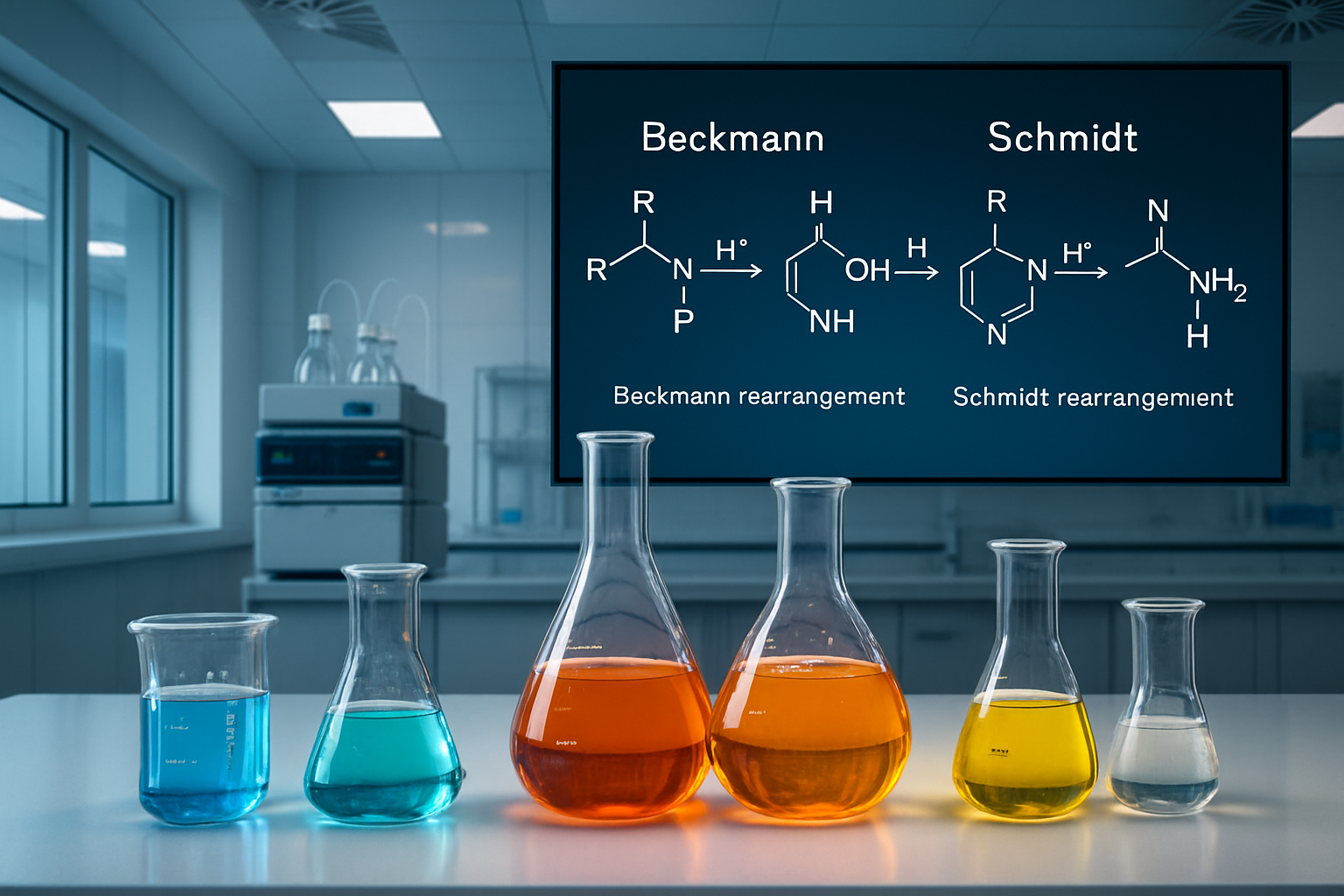
The article discusses key organic reactions in pharmaceutical chemistry, focusing on the Beckmann Rearrangement, Schmidt Rearrangement, and Claisen-Schmidt Condensation, detailing their mechanisms and applications in synthesizing complex compounds.
The study of organic reactions is fundamental in pharmaceutical chemistry, particularly for synthesising complex compounds. Among the significant reactions are the Beckmann Rearrangement, Schmidt Rearrangement, and Claisen-Schmidt Condensation. Each reaction has unique mechanisms and applications that are essential for developing various pharmaceutical agents.
Loading flowchart…
Beckmann Rearrangement Explained
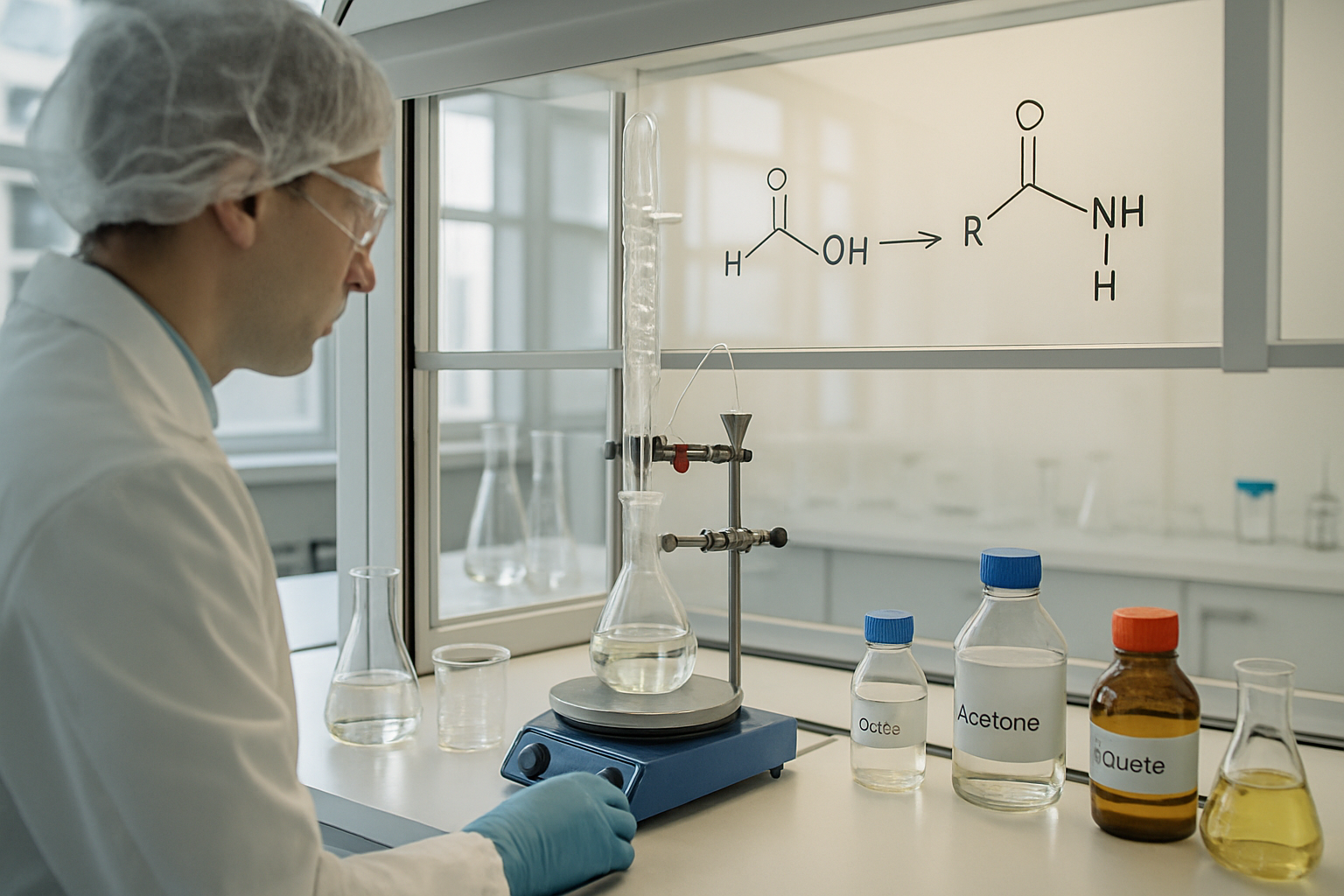
The Beckmann Rearrangement is a reaction involving oximes derived from aldehydes or ketones, converting them into either amides or nitriles. The transformation depends on the origin of the oxime: oximes from ketones yield amides, while those from aldehydes lead to nitriles. This rearrangement occurs under acidic conditions, where protonation facilitates the formation of a leaving group, typically from the hydroxyl part of the oxime. As the nitrogen atom transitions, it generates a carbocation, which subsequently reacts with water to form the amide.
Understanding the Reaction Process
The steps involved in the Beckmann Rearrangement are as follows:
- A ketone undergoes reaction with hydroxylamine, producing an oxime.
- The oxime experiences protonation, transitioning the nitrogen to a more reactive state.
- Loss of water occurs, breaking the N-O bond.
- The nitrogen is protonated again, leading to the formation of an amide through isomerization.
Insights into the Schmidt Rearrangement
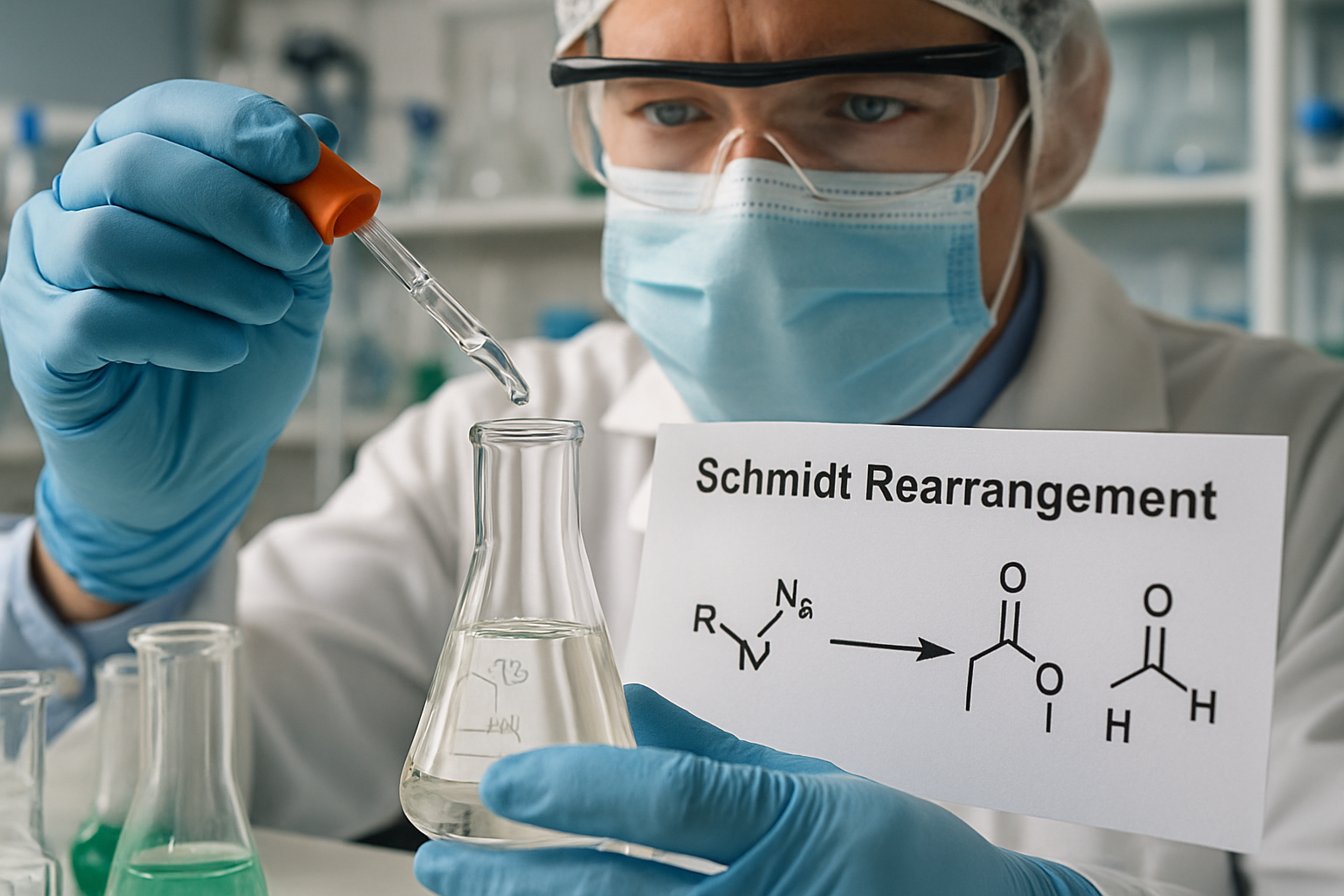
This reaction involves the interaction of azides with carbonyl compounds, leading to the formation of amines or amides. First reported by Schmidt in 1924, the reaction showcases the versatility of azides in organic synthesis.
Detailed Mechanistic Pathways
The Schmidt reaction can yield different products based on the starting materials:
- For azides reacting with ketones, the result is typically an amide.
- Conversely, azides reacting with carboxylic acids lead to amines.
For example, the reaction of an azide with a ketone, such as benzophenone, produces benzanilide, illustrating the formation of an amide. The mechanism involves:
- Protonation of the carboxylic acid forming an acylium ion.
- Formation of a protonated azido ketone from the acylium ion and hydrazoic acid.
- Rearrangement of this intermediate, resulting in the formation of a carbamate upon water attack.
- Final formation of an amine after deprotonation and CO2 removal.
Claisen-Schmidt Reaction Overview
The Claisen-Schmidt condensation is a significant reaction that involves the condensation of an aldehyde or ketone with an aromatic carbonyl compound lacking an alpha-hydrogen. The process yields aromatic aldehydes, enhancing the aromatic character of the product.
Sequential Steps in the Condensation
The Claisen-Schmidt condensation proceeds through four main stages:
- The reaction begins with acetaldehyde reacting with a base, generating a negatively charged intermediate.
- This intermediate then reacts with benzaldehyde, introducing the aromatic component.
- The resulting compound undergoes treatment with acid.
- Finally, elimination of water leads to the formation of the desired aromatic aldehyde.
When using sodium hydroxide and benzaldehyde, the reaction can achieve quantitative yields without solvents, demonstrating its effectiveness in synthesising stable aromatic products.
| Reaction | Starting Materials | Product |
|---|---|---|
| Beckmann Rearrangement | Oxime from Ketone | Amide |
| Beckmann Rearrangement | Oxime from Aldehyde | Nitrile |
| Schmidt Rearrangement | Azide + Ketone | Amide |
| Schmidt Rearrangement | Azide + Carboxylic Acid | Amine |
| Claisen-Schmidt Condensation | Aldehyde + Aromatic Carbonyl | Aromatic Aldehyde |
Comments (0)
Loading comments…
Checking sign-in status…