

The article discusses the chemical properties and applications of dichloromethane, tetrachloromethane, and iodoform, highlighting their roles in various industries, including pharmaceuticals and manufacturing. It details their structures, uses, and safety considerations.
Understanding the chemical properties and applications of various compounds is essential in the pharmaceutical and industrial sectors. This article outlines the structures and practical uses of dichloromethane, tetrachloromethane, and iodoform, focusing on their significance in manufacturing and other applications.
Dichloromethane Overview

Chemical Structure
Dichloromethane, commonly referred to as methylene dichloride or methyl chloride, has the chemical formula CH2Cl2. This compound is characterised by its colourless appearance and a sweet, penetrating odour. It is a volatile liquid and, while it is non-combustible, it can release toxic fumes when heated to high temperatures. These fumes can be narcotic in nature at elevated concentrations, which poses safety concerns during handling and use.
Applications
Dichloromethane serves multiple purposes across various industries:
- In food technology, it is employed as a solvent.
- This compound is also utilised in aerosol formulations.
- In the pharmaceutical industry, dichloromethane acts as a solvent during the manufacturing of various products.
- It is commonly used as a degreasing agent.
- Furthermore, it plays a role in electronics manufacturing.
Tetrachloromethane Characteristics
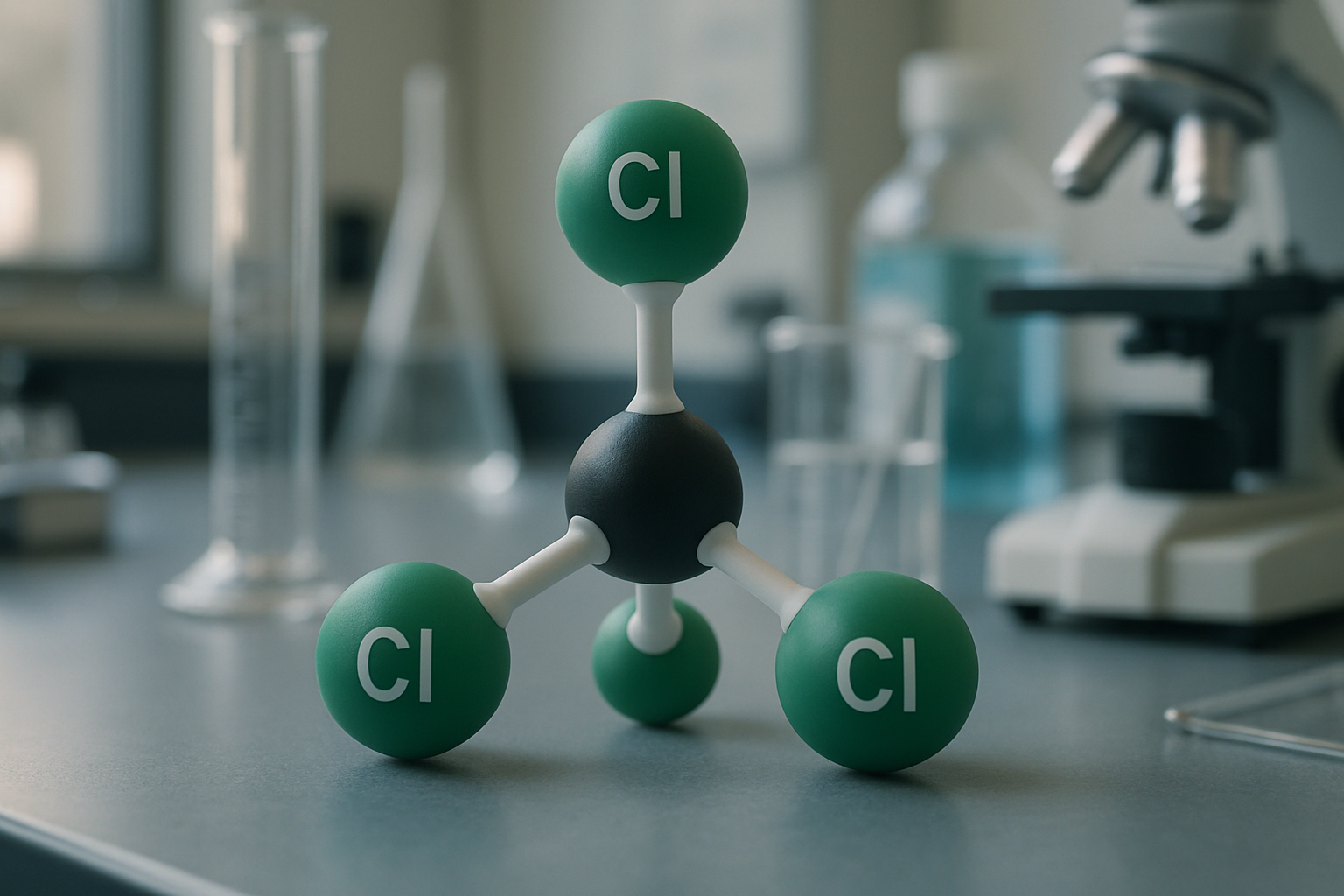
Chemical Structure
Tetrachloromethane, also known as carbon tetrachloride, features a tetrahedral molecular structure with one carbon atom bonded to four chlorine atoms. This symmetrical arrangement results in nonpolar properties due to the uniform distribution of charge around the central carbon atom.
Applications
Historically, carbon tetrachloride was widely used to produce chlorofluorocarbons for refrigeration until the 1980s. Its applications include:
- Manufacture of fire extinguishers and cleaning agents.
- Utilisation in specific reactions, such as the Appel reaction, as a chlorine source.
- Traditionally used in proton NMR spectroscopy.
However, due to its associated health risks and environmental damage, particularly its contribution to ozone layer depletion, many countries have restricted its use.
Iodoform Insights
Chemical Structure
The iodoform molecule has a C3V symmetry and a tetrahedral geometry, with the central atom bonded to four substituents. The structural formula illustrates that while the carbon atoms are located at the corners, the hydrogen atoms are not directly attached to the carbon atoms. Instead, each carbon atom forms bonds with hydrogen atoms, creating a stable configuration.
Applications
Iodoform has several notable applications, particularly in medical settings:
Comments (0)
Loading comments…
Checking sign-in status…