
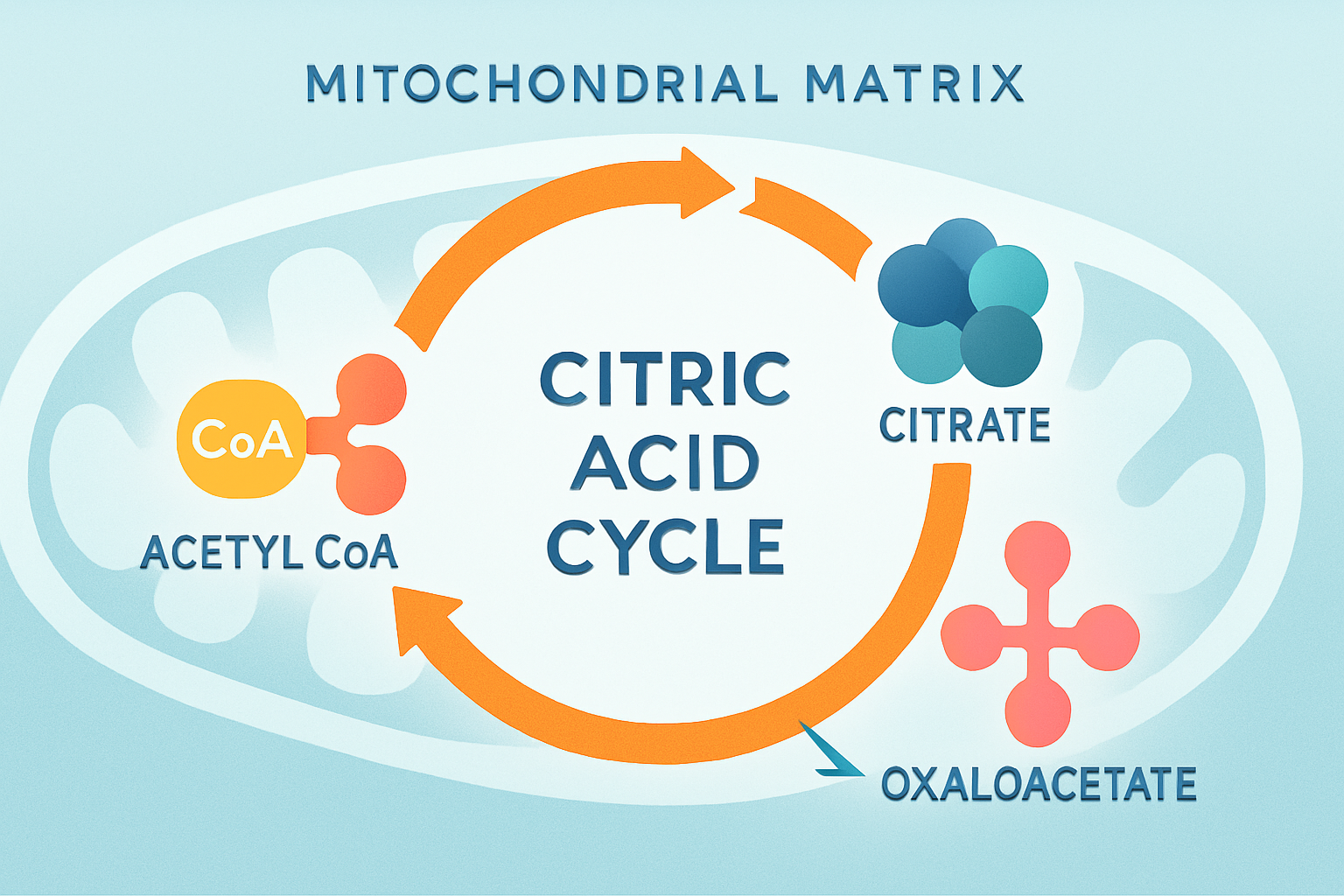
The citric acid cycle, or Krebs cycle, is vital for energy production and metabolic pathways, converting acetyl CoA into energy-rich molecules and intermediates for various biosynthetic processes. It occurs in the mitochondrial matrix and involves a series of enzymatic reactions that regenerate oxaloacetate.
The citric acid cycle, also known as the Krebs cycle, plays a crucial role in cellular metabolism by converting acetyl CoA into energy-rich molecules. This cycle not only facilitates energy production but also serves as a hub for various metabolic pathways, making it significant for both catabolic and anabolic processes.
Overview of the Citric Acid Cycle
The citric acid cycle occurs within the mitochondrial matrix, where acetyl CoA combines with oxaloacetate to form citrate. This pathway is characterised by a series of enzymatic reactions that ultimately regenerate oxaloacetate, allowing the cycle to continue. Unlike glycolysis, which is linear, the citric acid cycle is a closed loop, ensuring that intermediates are recycled.
Key Reactions in the Cycle
The cycle consists of several critical reactions:
- Formation of Citrate: Acetyl CoA combines with oxaloacetate to produce citrate. This step is highly exergonic and irreversible, regulated by ATP levels.
- Isomerisation: Citrate is converted into isocitrate through the addition and removal of water.
- Oxidative Decarboxylation: Isocitrate is oxidised to α-ketoglutarate, generating NADH and releasing CO2. This step is positively influenced by ADP.
- Formation of Succinyl CoA: α-Ketoglutarate undergoes further decarboxylation to form succinyl CoA, producing another NADH and CO2.
- Substrate-Level Phosphorylation: The conversion of succinyl CoA to succinate generates either GTP or ATP, depending on the tissue type.
- Reduction of Fumarate: Succinate is dehydrated to form fumarate, with FAD being reduced to FADH2 in the process.
- Hydration to Malate: Fumarate is hydrated to produce malate.
- Regeneration of Oxaloacetate: Malate is oxidised to regenerate oxaloacetate, yielding another NADH.
Products of the Citric Acid Cycle
Each turn of the citric acid cycle results in the production of:
- Two molecules of carbon dioxide
- One molecule of GTP or ATP
- Three molecules of NADH
- One molecule of FADH2
These end products are pivotal for the electron transport chain, where they contribute to the synthesis of ATP through oxidative phosphorylation.
Energetics of the Cycle
The overall energy yield from the citric acid cycle is significant. Each NADH can generate approximately 3 ATP, while FADH2 can yield about 2 ATP. Thus, one acetyl CoA can ultimately produce around 12 ATP when considering the contributions from NADH and FADH2, along with the direct ATP or GTP produced.
Significance in Metabolism
The citric acid cycle is not only essential for energy production but also serves various metabolic functions. It is a central pathway for the oxidation of carbohydrates, fats, and proteins. The cycle provides intermediates for the synthesis of non-essential amino acids and other biomolecules, illustrating its amphibolic nature.
Integration with Other Metabolic Pathways
In addition to its role in energy metabolism, the citric acid cycle is intricately linked to other pathways. For instance:
- Amino acids can be converted into cycle intermediates, such as α-ketoglutarate and oxaloacetate, through deamination.
- Fatty acids undergo β-oxidation to form acetyl CoA, which enters the cycle.
This integration highlights the cycle's versatility and importance in maintaining metabolic homeostasis.
Regulation and Clinical Relevance
The citric acid cycle is tightly regulated by the availability of substrates and the energy status of the cell. Enzyme activity can be influenced by the concentrations of NAD+, ATP, and other metabolites. Disruptions in the cycle can lead to metabolic disorders, particularly affecting the liver, which is central to many metabolic processes.
Genetic defects in enzymes of the cycle can result in severe neurological and metabolic symptoms, emphasising the need for proper functioning of this pathway.
Vitamin Dependence
Several vitamins act as cofactors for enzymes within the citric acid cycle, including niacin, riboflavin, thiamine, and pantothenic acid. Their availability is crucial for the cycle's efficiency and overall metabolic health.
Conclusion
The citric acid cycle is a fundamental metabolic pathway that not only generates energy but also connects various biochemical processes. Understanding its mechanisms and significance is essential for comprehending cellular metabolism and its implications for health and disease.
| Cycle Component | Production |
|---|---|
| NADH | 3 per cycle |
| FADH2 | 1 per cycle |
| ATP/GTP | 1 per cycle |
| CO2 | 2 per cycle |
Comments (0)
Loading comments…
Checking sign-in status…