

critical process in pharmaceutical manufacturing that ensures the effectiveness of sterilization methods. Proper validation confirms the reliability of biological indicators, which are essential for maintaining product safety and compliance with regulatory standards.
In pharmaceutical manufacturing, the sterility of products is critical, particularly for those intended for parenteral use. The effectiveness of sterilization processes directly influences product safety and quality. Biological Indicators (BIs) serve as a crucial tool in this context, providing a means to demonstrate that sterilization methods are both effective and reliable. However, their implementation is only as effective as the validation process that underpins them.
Understanding Biological Indicators

Biological indicators are standardized preparations containing a specific number of viable microorganisms that exhibit a known resistance to sterilization techniques. They’re employed to challenge the sterilization conditions, confirming that these conditions are adequate to eliminate resistant microorganisms. Typically, a biological indicator includes:
- Microbial spores with inherent resistance.
- A carrier medium, such as a strip, disc, ampoule, or suspension.
- Protective packaging.
The presence of resilient spores implies that if they are successfully eradicated, the sterilization process is likely effective.
Significance of Biological Indicators
Biological indicators are paramount for assessing the effectiveness of sterilization protocols. Unlike physical or chemical indicators that offer indirect evidence, BIs provide solid microbiological confirmation of sterilization success. Their applications include:
- Validating sterilization cycles.
- Routine monitoring of sterilization efficacy.
- Protection of patient health.
- Compliance with regulatory standards.
Categories of Biological Indicators
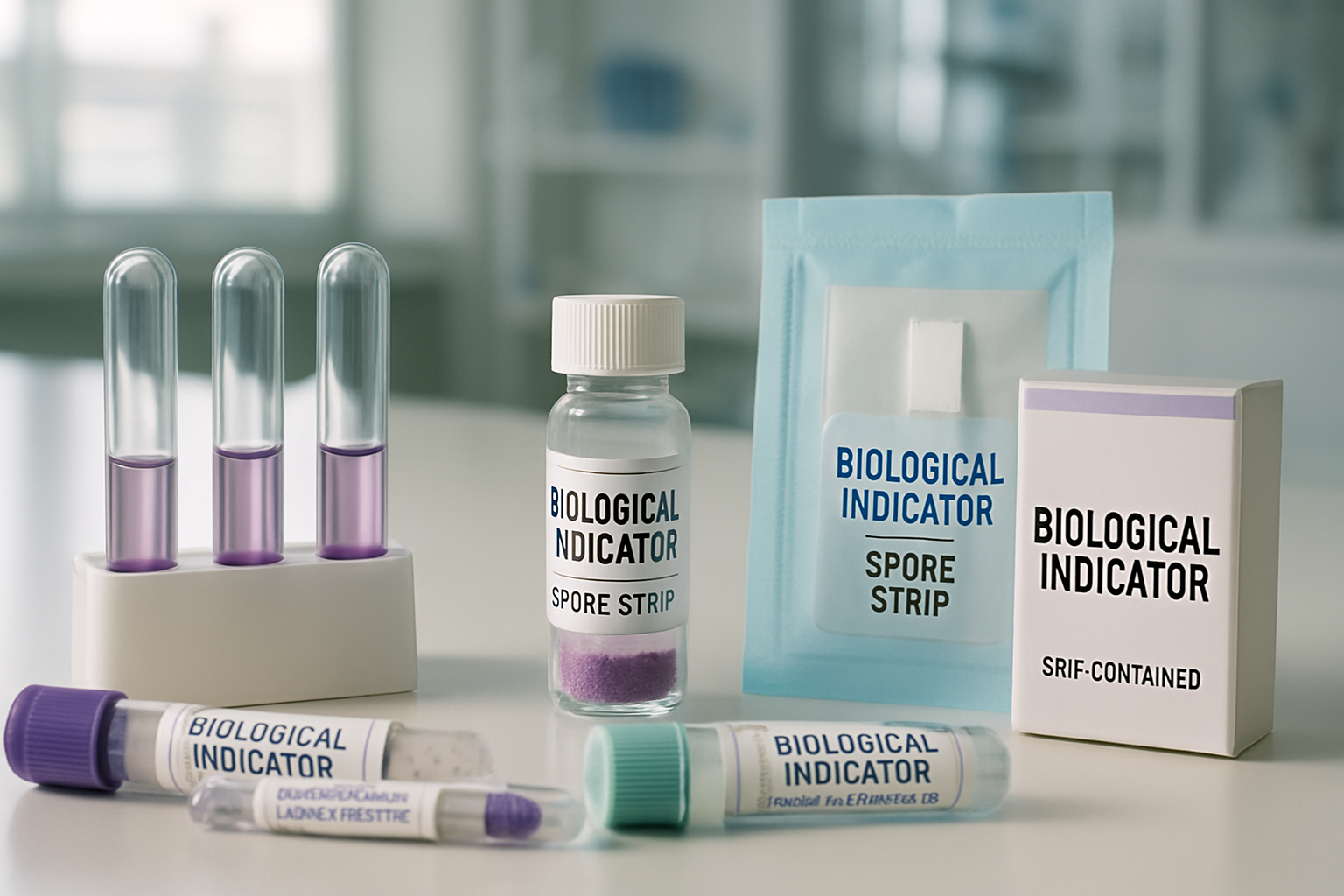
Different types of biological indicators are employed to match various sterilization methods:
1. Indicators for Steam Sterilization
These typically utilise spores of Geobacillus stearothermophilus, known for their significant resistance to steam.
2. Indicators for Heat Sterilization
Bacillus atrophaeus spores are generally used for validating dry heat sterilization processes.
3. Indicators for ETO Sterilization
The same Bacillus atrophaeus spores serve as the biological benchmark for ethylene oxide sterilization.
4. Indicators for Vaporized Hydrogen Peroxide Sterilization
Biological indicators for this method contain spores specifically tailored for conditions prevalent in vaporized hydrogen peroxide sterilization.
Core Attributes of Biological Indicators
Effective biological indicators exhibit certain key characteristics:
- Resistance to the sterilization method employed.
- Capacity to maintain a stable spore population over time.
- Consistent performance in terms of spore viability.
- Ease of recovery post-exposure to sterilization conditions.
The resistance of a biological indicator is often quantified using the D-value.
Defining D-Value
D-value represents the time required to achieve a 90% reduction in the microbial population—equivalent to a single log reduction. A higher D-value indicates greater resistance of the biological indicator.
Overview: importance of D-Value
D-value plays a vital role in assessing:
- The effectiveness of the sterilization process.
- The challenge level posed by the biological indicator.
Overview: validation of Biological Indicators
Validating a biological indicator ensures its reliability and appropriateness for monitoring sterilization processes. This includes verifying:
- The correct organism is utilised.
- The spore population meets specifications.
- Resistance characteristics are acceptable.
- The recovery method is dependable.
Reasons for Validation Necessity
Inaccurate or unreliable biological indicators can lead to faulty conclusions, such as:
- Release of non-sterile products.
- Unwarranted batch rejections.
- Regulatory non-compliance.
Proper validation instills confidence in the monitoring of sterilization processes.
Steps in Validating Biological Indicators
Loading flowchart…
The validation process involves a systematic approach:
Overview: step 1: Define Scope and Objectives
The validation protocol should clearly outline the:
- Specific sterilization process.
- Target organism.
- Acceptance criteria.
- Testing methodologies.
The aim is to confirm that the selected organism functions effectively as a biological indicator.
Step 2: Confirm Organism Identity
Verification of the organism’s identity is critical. This includes:
- Confirming the strain used.
- Ensuring the purity of the organism.
- Validating the organism as per supplier specifications.
Step 3: Validate Spore Population
The BI must contain the designated number of spores. Verification involves:
- Recovering spores from the indicator.
- Performing serial dilutions.
- Conducting a microbial plate count.
- Comparing results against specifications.
Step 4: Establish D-Value
To determine the D-value:
- Expose biological indicators to sterilization conditions for various timeframes.
- Recover the surviving spores.
- Calculate the log reduction from the results.
- Derive the D-value mathematically.
This process demonstrates the biological indicator’s challenge to the sterilization method.
Overview: step 5: Study Survival and Kill Time
The aim is to ascertain the performance of indicators under sterilization conditions:
- Survival Time: The shortest period an indicator remains functional.
- Kill Time: The duration needed to ensure complete destruction of the indicators.
Step 6: Validate Recovery Method
Post-sterilization, there should be a reliable process to recover any surviving microorganisms. This includes:
- Incubating in suitable growth mediums.
- Verifying microbial growth.
- Ensuring the growth medium is conducive for recovery.
Step 7: Confirm Incubation Conditions
Proper incubation conditions are vital for microbial growth. Validation should verify:
- Incubator temperature.
- Duration of incubation.
- Suitability of growth media.
Step 8: Conduct Growth Promotion Testing
To ensure recovery mediums are effective, the following steps are needed:
- Inoculate the growth medium with a low microbial population.
- Incubate according to defined conditions.
- Observe the growth of microorganisms.
Step 9: Documentation and Reporting
All validation activities must be thoroughly documented. Essential documentation includes:
- Validation protocol.
- Raw data.
- Test results.
- Final reports.
Establishing Acceptance Criteria
Validation protocols must define clear acceptance criteria to evaluate biological indicators effectively. This should include:
- Verification of microorganism identity.
- Confirmation of adequate spore count.
- Establishing D-value within predefined limits.
- Successful recovery of viable organisms.
- Observation of expected survivor and kill counts.
Challenges in Validating Biological Indicators
During validation, common challenges may arise, such as:
- Variable spore counts.
- Incorrect incubation conditions.
- Inadequate recovery techniques.
- Testing contamination.
Proper planning and strict adherence to aseptic techniques can mitigate these issues.
Routine Use of Biological Indicators
Once validated, BIs should be routinely employed to monitor sterilization processes, such as:
- Autoclave cycle verification.
- Sterilizer qualification.
- Load validation.
Regular usage of BIs reinforces ongoing sterilization efficacy.
Revalidation Triggers
Revalidation may be required in instances such as:
- Alterations in sterilization cycles.
- Change of biological indicator supplier.
- Modifications to incubation methods.
- Adjustments to sterilization equipment.
Expectations from Regulatory Bodies
Regulatory authorities mandate that biological indicators must meet specific requirements, including:
- Scientific justification for their use.
- Thorough validation procedures.
- Routine monitoring practices.
- Accurate documentation of all processes.
Recommended Practices for Validation
Best practices for the validation of biological indicators encompass:
- Utilising certified biological indicators.
- Adhering to established microbiological protocols.
- Validating recovery techniques thoroughly.
- Keeping comprehensive records.
- Providing adequate training for personnel.
In summary, validating biological indicators is a vital component of ensuring the integrity of sterilization processes in pharmaceutical manufacturing. This validation supports the reliability of sterilization controls, reinforcing the assurance of both product quality and patient safety.
Comments (0)
Loading comments…
Checking sign-in status…