

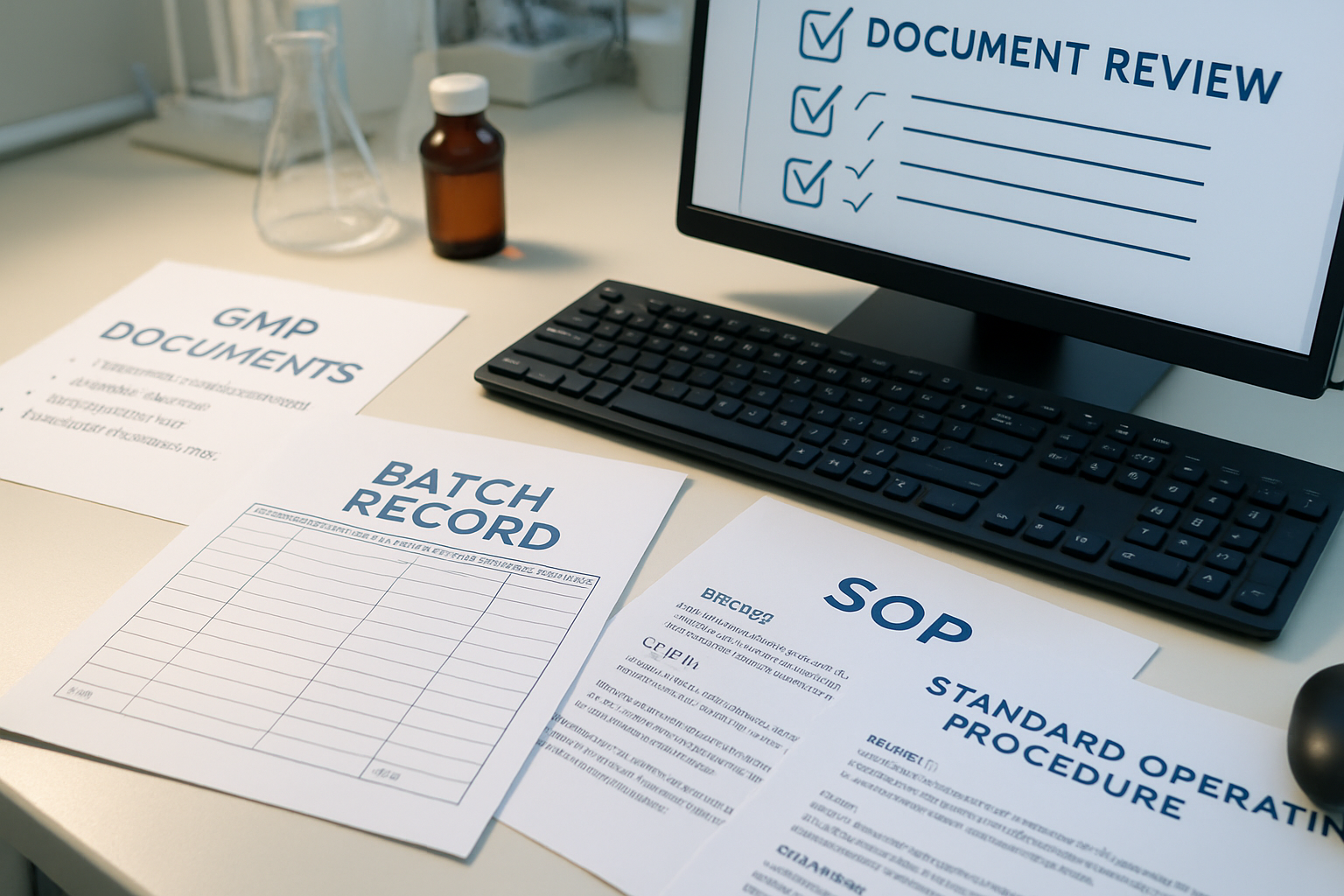
A rigorous review of GMP documentation is essential for compliance and product quality in the pharmaceutical industry. Key documents must be meticulously evaluated to prevent errors that could lead to serious consequences, including regulatory scrutiny and patient safety risks.
A rigorous approach to reviewing GMP documentation is vital in the pharmaceutical industry, ensuring compliance with regulatory standards and maintaining the integrity of product quality. Documents such as batch manufacturing records, standard operating procedures (SOPs), validation reports, and deviation logs must undergo meticulous scrutiny. Even minor errors in these documents can lead to serious consequences, including product recalls or risks to patient safety. A systematic and confident reviewing process is essential for professionals in QA/QC roles.
Importance of GMP Document Evaluation

In the context of Good Manufacturing Practice (GMP), reviewing documents is crucial for several reasons:
- Maintaining data integrity throughout the documentation process.
- Ensuring adherence to established standard operating procedures.
- Documenting, investigating, and justifying deviations appropriately.
- Verifying the quality of the final product.
- Achieving compliance with standards set forth by the FDA, EMA, and WHO.
Regulatory agencies scrutinise documentation thoroughly, making inadequate reviews a leading cause of 483 observations and warning letters.
Structured Approach to GMP Document Reviews
Loading flowchart…
Overview: 1. Clarify the Document's Type and Purpose
Each GMP document serves a distinct function. For instance:
- **Batch Manufacturing Record (BMR):** Verifies that the product is manufactured according to the approved process.
- **Standard Operating Procedure (SOP):** Outlines the repeatable steps necessary for maintaining process consistency.
- **Validation Protocols and Reports:** Demonstrate that processes are both reproducible and consistent.
- **Deviation Reports:** Address and justify any abnormalities encountered during manufacturing.
Understanding the intent and regulatory significance of each document is essential for effective review.
Overview: 2. Verify Version Control and Approvals
During the review, confirm the following:
- The document is the correct version, as indicated by the version number.
- It has been properly approved and signed by an authorised individual.
- Effective dates and control numbers are present.
This practice avoids the use of outdated SOPs and protocols, which can lead to compliance issues.
Overview: 3. Apply ALCOA+ Principles
The ALCOA+ framework emphasises:
- **Attributable:** Each entry should be traceable to an individual.
- **Legible:** Handwriting must be clear.
- **Contemporaneous:** Data should be recorded in real-time.
- **Original:** Maintain original entries without alterations.
- **Accurate:** Ensure all data is correct.
- **Complete:** All necessary information must be present.
- **Consistent:** Data should be uniform and reliable.
- **Enduring:** Records must be durable and easily retrievable.
- **Available:** Data should be accessible when needed.
Check document entries and signatures against these principles for thoroughness.
4. Cross-Verify with SOPs and Protocols
Documents such as BMRs and logs should adhere strictly to established SOPs. During your review:
- Confirm adherence to operational procedures.
- Document any deviations accompanied by appropriate corrective and preventive actions.
- Ensure that raw materials, instruments, and parameters align with defined protocols.
For example, if an SOP mandates visual inspection after compression, ensure this action is duly noted in the BMR.
5. Assess Legibility and GDP Compliance
Evaluate documents against general good documentation practices (GDP). Key points to check include:
- No overwriting; use single line strikethroughs for corrections.
- All corrections should be signed and dated.
- Avoid correction fluid; mistakes should remain visible.
- Entries must be made in indelible ink.
- Do not leave blank fields; use 'N/A' where applicable.
- Dates should be formatted consistently (DD-MM-YYYY) and time entries in 24-hour format, where relevant.
6. Confirm Document Completeness
A document is incomplete if it lacks even one mandatory component. Verify for:
- Signatures of responsible personnel.
- Equipment ID and calibration status.
- Raw material batch/lot numbers.
- Data logs (temperature, pressure, weight, and times).
- Required attachments like graphs and tables.
Incomplete documentation is a frequent GMP violation that warrants immediate attention.
7. Evaluate Data Consistency
Consistency demonstrates effective process control. Look for:
- Uniformity in recorded times and ideal process durations.
- No discrepancies between BMRs, logbooks, and QC reports.
- Reproducibility across multiple batches.
Inconsistent data can raise red flags during audits.
8. Assess Deviation Management and Investigations
All deviations must be documented, investigated, and justified, with clear links to corrective and preventive actions (CAPA). During review, scrutinise any explanations that attribute deviations to simple human error without further analysis.
9. Review Signatures and Authorisations
Document approvals confirm accountability and should not be treated as mere formalities. Ensure that:
- All process sections have the appropriate signatures from responsible operators or supervisors.
- Review and verification signatures include dates.
- Quality assurance has provided final approval for the document.
Missing or incorrect signatures can render a document invalid, complicating batch release.
10. Establish Traceability
Each document should be traceable through:
- Raw materials to finished products.
- SOPs to manufacturing steps.
- Deviations to CAPA closures.
- Test results back to source data, including instruments and logs.
Effective traceability affirms the authenticity of processes and analyses.
Common Errors to Identify During Document Reviews
Reviewers should be vigilant for typical mistakes, including:
- Entries made before the activity occurs.
- Backdated entries in process logs.
- Data inconsistencies (e.g., weight discrepancies).
- Unexplained abbreviations.
- Missing attachments or signatures.
- Copy-paste errors in electronic records.
A thorough document review can prevent serious mistakes if addressed early.
Overview: recommended Practices for Document Reviewers
Stay informed about the latest GMP guidelines from authorities such as the FDA, EU-GMP, and WHO. Utilise checklists to streamline reviews and minimise errors. Avoid hasty evaluations, since rushing can overlook critical details. Collaborate with quality assurance, production, and quality control teams whenever uncertainty arises. Regular training in good documentation practices, data integrity, and quality management systems is also advisable. Document review within a GMP framework is a safeguard for product quality and public health. A meticulous and traceable review process supports regulatory compliance and product integrity, making it essential for internal audits and inspections.
Comments (0)
Loading comments…
Checking sign-in status…