

The FDA conducts inspections of pharmaceutical manufacturing facilities to ensure compliance with safety and quality standards. These inspections can be routine, pre-approval, or triggered by specific issues, and involve thorough documentation reviews and staff interviews.
The FDA plays a crucial role in ensuring that pharmaceutical products are safe, effective, and of high quality. Regular inspections of manufacturing facilities, both domestic and international, are conducted to assess compliance with current Good Manufacturing Practices (cGMP). Understanding the intricacies of these inspections is vital for manufacturers to maintain compliance and prevent potential issues that could adversely affect their operations.
Objectives of FDA Inspections
The inspections serve to confirm whether facilities adhere to the Federal Food, Drug, and Cosmetic Act (FDCA) and comply with cGMP guidelines specified in 21 CFR Parts 210 and 211. Inspectors evaluate whether the manufacturing processes consistently produce products that meet safety, efficacy, and quality standards. Additionally, the inspections verify that quality management is integrated throughout the production process.
Categories of FDA Inspections
The FDA conducts several types of inspections, each serving different purposes:
- Pre-Approval Inspection (PAI): This inspection focuses on granting marketing approval for new products, ensuring that facilities can produce drugs according to submitted applications and that analytical methods have been validated.
- Routine cGMP Inspection: These inspections verify ongoing compliance with cGMP requirements and typically occur every two to three years for domestic facilities.
- For-Cause Inspection: Triggered by specific events such as recalls or complaints, these inspections address narrow, issue-based concerns.
- Follow-Up Inspection: Conducted to confirm that a facility has properly implemented corrective actions from previous inspections.
- Foreign Inspections: These inspections ensure that international facilities shipping products to the U.S. meet the same quality standards as domestic sites.
Inspection Notifications and Triggers
FDA inspections may be either announced or unannounced. Generally, routine or pre-approval inspections are announced a few days in advance, whereas for-cause or follow-up inspections typically occur without prior notice. Common triggers for inspections include:
- Applications for new drug or abbreviated new drug approvals (NDA and ANDA).
- Product recalls or quality complaints.
- Reports of adverse events associated with a product.
- Flags raised due to issues of data integrity.
- Notable deviations from the regulations outlined in 21 CFR 314.81.
- Facilities consistently prepared for inspections as part of their compliance with cGMP.
Process of an FDA Inspection

Loading flowchart…
The structure of an FDA inspection follows a defined process outlined in the Investigations Operations Manual (IOM) and Compliance Programs Guidance Manuals (CPGMs). Here are the main phases:
Initial Preparation
Prior to the inspection, FDA investigators review relevant information about the facility, including:
- Product submissions and annual reports.
- History of previous inspections and observations.
- Manufacturing processes and facility layouts.
Arrival and Introduction (Form 482)
Upon arrival, investigators present their credentials and issue Form 482, the Notice of Inspection. This introductory meeting establishes the scope of the inspection, logistics for the visit, and the names of company representatives.
Overview: facility Tour and Observations
The initial phase involves walking through the facility, during which the investigator assesses equipment cleanliness, personnel practices, material flow, and environmental controls. Initial observations can significantly impact the inspection outcome.
Review of Documentation
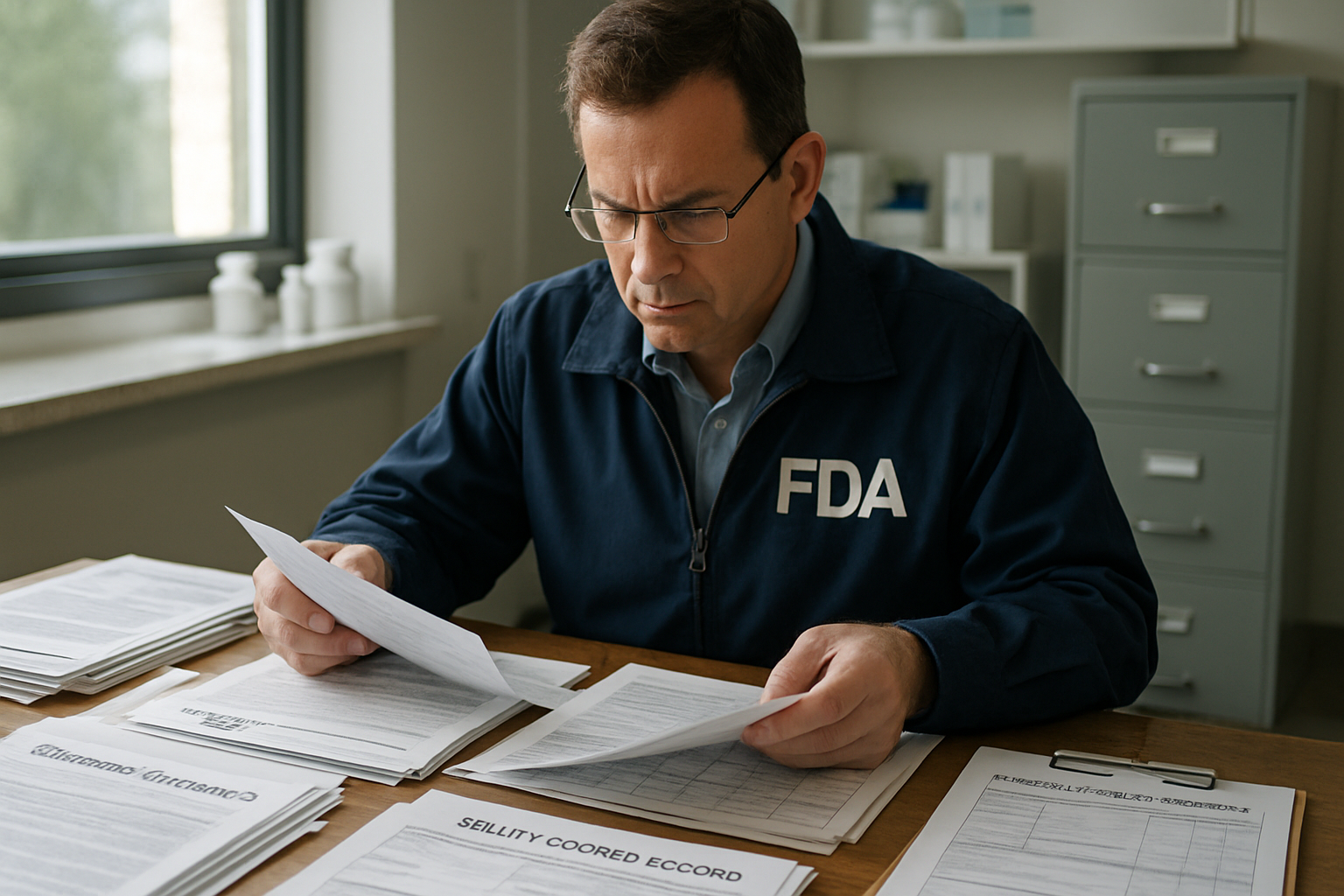
Documentation review is a key focus, encompassing:
- Batch manufacturing records (BMRs).
- Standard operating procedures (SOPs).
- Quality control data and validation records.
- Deviation records and corrective action/preventive action (CAPA) documentation.
- Training and calibration logs.
Inspectors check that records adhere to the ALCOA principle (Attributable, Legible, Contemporaneous, Original, Accurate).
Staff Interviews
Interviews with personnel at all levels are conducted to determine their understanding and adherence to established procedures. Inspectors may also request demonstrations of tasks to confirm compliance with documented practices.
Daily Summation Meetings
During longer inspections, the FDA holds daily wrap-up meetings to summarise findings and clarify any information requests.
Conclusion Meeting (Form 483)
At the end of the inspection, an exit meeting is held with senior management where FDA officials discuss their findings, documented on Form 483. This meeting allows the company to respond to observations before the final report is compiled.
Common Focus Areas During Inspections
Over time, the FDA has identified frequent non-compliance areas, including:
- Data integrity issues, including falsified records.
- Quality system deficiencies, especially in handling deviations and CAPA.
- Lapses in process validation.
- Equipment maintenance and calibration shortcomings.
- Contamination control and cleanliness practices.
- Employee training on hygiene and product handling.
- Supplier qualification processes.
Potential Outcomes After an Inspection
Post-inspection, the FDA may determine one of three outcomes:
- No Action Indicated (NAI): No deficiencies found, no enforcement action required.
- Voluntary Action Indicated (VAI): Minor deficiencies identified that require corrective actions but no penalties.
- Official Action Indicated (OAI): Serious deficiencies observed, potentially leading to enforcement actions.
Responding to Form 483
Upon receiving Form 483, companies should respond within 15 working days, detailing corrective and preventive actions taken. Providing thorough and transparent responses can significantly reduce the likelihood of receiving a warning letter.
Consequences of Non-Compliance
The FDA issues warning letters when companies fail to address significant violations. Such letters detail the issues and often set a deadline for corrective actions. In serious cases, enforcement actions may include:
- Import restrictions.
- Product recalls and seizures.
- Legal actions such as consent decrees or criminal prosecutions.
Preparation Strategies for FDA Inspections
Effective preparation for FDA inspections should be an ongoing effort rather than a last-minute rush. Key strategies include:
- Continuous adherence to cGMP.
- Regular employee training on inspection processes.
- Conducting mock inspections annually.
- Organising records for easy access.
- Maintaining data integrity in both electronic and paper records.
- Timely handling of deviations and documenting CAPA.
- Keeping facilities clean and well-maintained.
Recent Developments in FDA Inspections
Current trends in FDA inspections involve risk-based approaches, remote inspections via virtual document reviews, and a heightened focus on data integrity and global regulatory harmonisation.
Post-Inspection Procedures
Following an inspection, the FDA prepares an Establishment Inspection Report (EIR) that details findings, discussions on corrective actions, and the final classification. The EIR is sent to the company after completion, marking the conclusion of the formal inspection process.
Common Questions Regarding FDA Inspections
Overview of the role of an FDA inspection?
The role of an FDA inspection is to assess compliance with regulatory standards and ensure the safety and quality of pharmaceutical products.
How frequently does the FDA conduct inspections?
Inspections occur based on the facility's risk profile, typically every two to three years for domestic manufacturers.
What documentation is represented by Form FDA 482?
Form FDA 482, the Notice of Inspection, outlines the purpose and scope of the inspection as communicated to the company.
What does Form FDA 483 signify?
Form FDA 483 documents observations made by the FDA during an inspection when conditions or practices appear to violate regulatory requirements.
What happens after a company receives Form 483?
Following receipt of Form 483, the company must respond with corrective actions within 15 working days to address the identified issues.
What distinctions exist between NAI, VAI, and OAI classifications?
NAI indicates no deficiencies, VAI indicates minor issues requiring corrective action, and OAI signifies serious non-compliance that may lead to enforcement actions.
Do FDA inspections ever occur without prior notice?
Yes, for-cause and follow-up inspections are generally unannounced.
Overview: how should companies prepare for an FDA inspection?
Preparation should be an ongoing effort involving regular training, mock inspections, and strict adherence to cGMP.
Comments (0)
Loading comments…
Checking sign-in status…